

21 Aug. 2026: The Colonization & Wall Resistance Commission’s database records 87 Palestinians killed in or as a result of attacks by Israeli settlers between the beginning of 2019 and 21 August 2026. Twenty-five of these deaths have occurred since the start of 2026. Since 7 October 2023 alone, 61 Palestinians have been killed, representing just over 70% of all cases recorded during the entire period.
An unprecedented temporal escalation
The annual series shows a sharp transformation in the scale of lethal settler violence. Two deaths were recorded in 2019, one in 2020, five in 2021 and six in 2022. The number then rose to 23 in 2023, followed by 11 in 2024 and 14 in 2025. By 21 August 2026, the toll had already reached 25—the highest annual figure in the dataset and approximately 79% above the total recorded during all of 2025.
The monthly distribution also reveals concentrated waves of lethal violence linked to large attacks: ten deaths were recorded in October 2023, nine in March 2026 and seven in July 2026. This concentration demonstrates that the increase cannot be reduced to scattered individual incidents; it includes attacks producing several deaths in the same community and on the same day.
Ramallah and Nablus at the centre of the Israeli Terror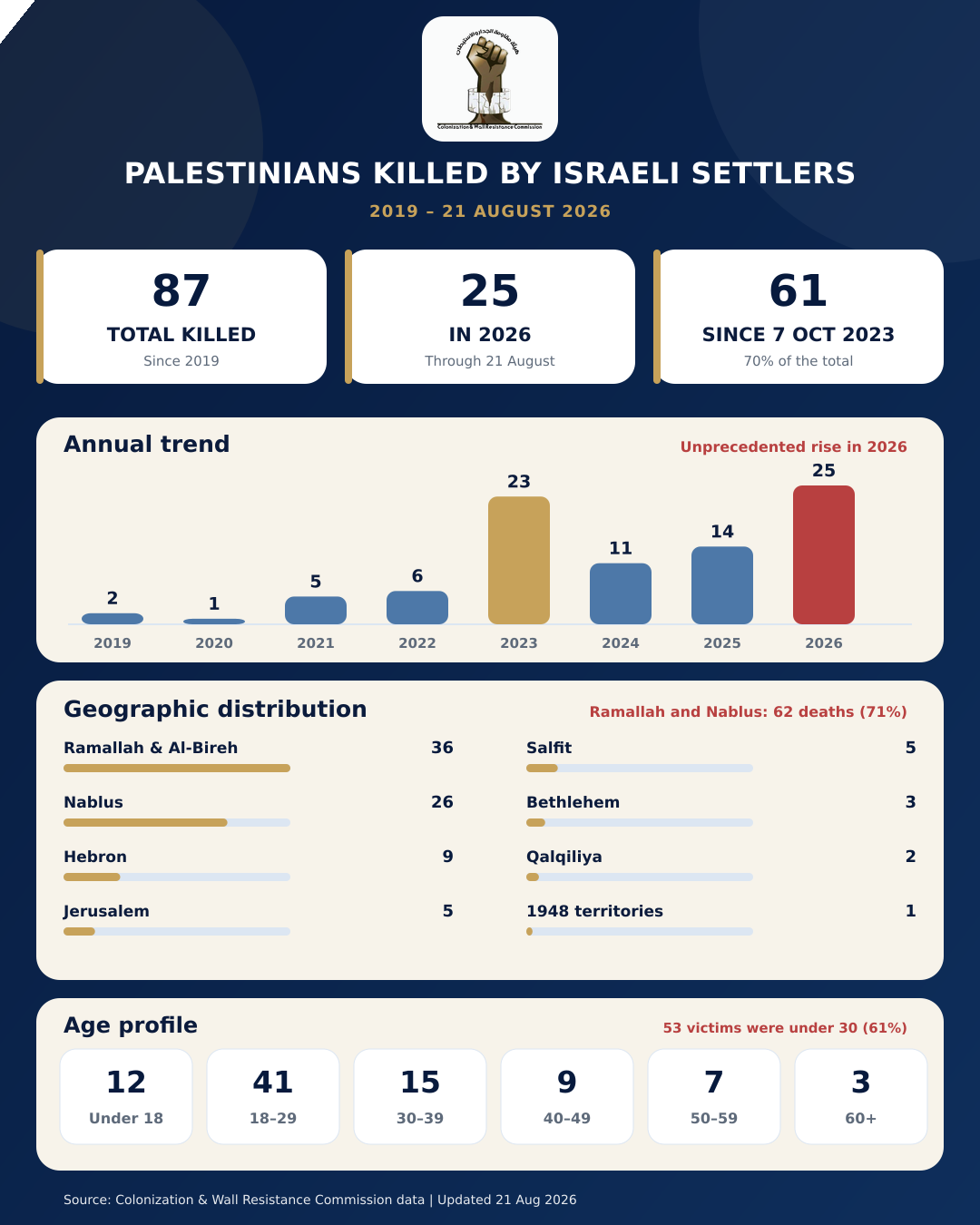
Geographically, Ramallah and Al-Bireh Governorate recorded 36 deaths, or about 41% of the total, followed by Nablus with 26, or roughly 30%. Together, the two governorates account for 62 deaths—71% of all recorded cases. Hebron recorded nine deaths; Jerusalem and Salfit five each; Bethlehem three; and Qalqiliya two. One additional case is listed in the source register under the 1948 territories.
This concentration points to a close relationship between the geography of lethal violence and areas experiencing rapid settlement-outpost expansion and repeated attacks on Palestinian villages, roads and agricultural land. Settler violence does not operate outside the settlement project; it serves as a means of intimidating communities, restricting access to land and creating conditions for seizure and displacement.
A disproportionately young death toll
Twelve of those killed were children under 18, representing nearly 14% of the total. A further 41 were between 18 and 29. Combined, 53 victims were under the age of 30—61% of all recorded deaths. The dataset also includes 15 people aged 30–39, nine aged 40–49, seven aged 50–59 and three aged 60 or above. Ages ranged from 14 to 72; the median age was 26 and the average was approximately 30.
Organised violence sustained by impunity
These figures cannot be described as the outcome of incidental friction. Their temporal recurrence, geographic concentration and the number of victims killed in group attacks point to a broader pattern in which settler violence functions as an instrument of territorial control and displacement. The danger is intensified by military protection, the arming of settlers, the proliferation of outposts and the near-total absence of meaningful accountability for perpetrators and those who enable them.
This escalation did not arise in a vacuum. Since Israel’s far-right, fascistic government was sworn in on 29 December 2022, the most extreme forces in the settlement movement have moved from the margins of incitement to the centre of executive power. The political, legal and security environment has become more enabling: outposts are expanded and regularised, protection and resources are extended, access to firearms is facilitated, and investigations and prosecutions fail to produce real deterrence. The practical message to violent settlers is unmistakable: their violence is not outside policy; it is an instrument for reshaping the land and forcing Palestinians to leave.
On the ground, the line between settler and soldier is increasingly blurred. Armed settlers serve in civilian security squads or military reserve roles; Israeli forces accompany some attacks or fail to stop them; and state-issued weapons, equipment and training enable a functional exchange between civilian violence and military force. The international response remains hesitant and inconclusive: limited, selective sanctions have targeted individuals and networks while the official policies and settlement infrastructure enabling the violence face no meaningful cost. In 2025, the United States even revoked the sanctions framework it had used against persons implicated in West Bank violence. This double standard—protecting civilians in principle while disabling accountability in practice—gives the system of violence more time and space to expand.
The Commission calls on the international community to move from condemnation to accountability: impose targeted sanctions on perpetrators and the state officials and organisations enabling them; end financial and commercial support for settlements; provide effective protection for threatened Palestinian communities; and ensure that these crimes are pursued through international legal mechanisms. Continued impunity does not merely allow attacks to recur—it gives a green light for wider and more lethal violence.